









Top 10 Best Private Search Engines That Do Not Track in 2026
Key takeaways:
- Google and others rely on collecting your data to make a profit, while alternative search engines try to balance accurate results with private search.
- Startpage, DuckDuckGo, and Brave search are the most popular, but others in our list stand out with advanced features.
- Most private search engines will still require you to take additional measures, such as using a VPN, to browse the web privately.

Guoda Šulcaitė
10 min read

Traditional search engines make money by collecting user data. Logging of IP addresses for location, cookies for search history, and account syncing across devices for browsing history are just a few ways of tracking you. Turning off safe search and such tracking features isn't a solution.
It's enough to Google a product a few times, and all your social media platforms flare up with targeted ads. Such tracking may be useful in niches like music streaming, but you don't want a search engine to collect your data. You can fight against such personal violations with privacy-focused search engines.
They are an alternative to mainstream engines that prioritize user privacy by avoiding the collection, tracking, or profiling of personal data during searches. Learning about some of the best privacy-focused search engines from our list will give you a choice to stay more private when you want.
Why Use a Private Search Engine?
Traditional search engines make money by collecting user data. Logging of IP addresses for location, cookies for search history, and account syncing across devices for browsing history are just a few ways of tracking you. Turning off safe search and such tracking features isn't a solution.
Search engine results will get more limited or even outright inaccurate. A common excuse is that tracking is essential for the search engine to function properly. The best search engines for privacy prove otherwise. They let you search privately with minimal data collection while still ensuring accurate results.
- Minimal personal profiling. Private search engines avoid account systems entirely and typically don't log IP addresses, so there are no ties to your past search results.
- Answers based on the current query. Since no search or browsing history is kept, your past searches don't impact what you're currently searching for.
- More neutral results. Private search engines avoid personalization and base rankings on general relevance, so you get not what Google thinks you want to see, but actual search results.
- Fewer trackers. Privacy search engines operate with minimal third-party trackers and other tools, reducing the exposure to cross-site tracking as much as possible.
- Private infrastructure. Many private search engines use independent indexes or work as a proxy, making searches in Google or Bing on your behalf. As such, there are fewer parties handling your data and making money from it.
Privacy-focused search engines still need to make money, but they do it in less intrusive ways. Ordinary ads and affiliate links are still common. From an advertiser's perspective, such ads are much less effective, but many users strive for such search engines.
Anyone concerned about search data collection, especially journalists, activists, and researchers, should look for ways to search privately. To be completely safe, it's equally important to use other privacy tools like VPNs, private DNS, and privacy browsers.
Top 10 Private Search Engines in 2026
All the alternative search engines we collected strike a slightly different balance between ensuring your privacy and providing accurate search results. Each can ensure a more private search than traditional search, so consider their convenience and additional features as well.
1. Startpage
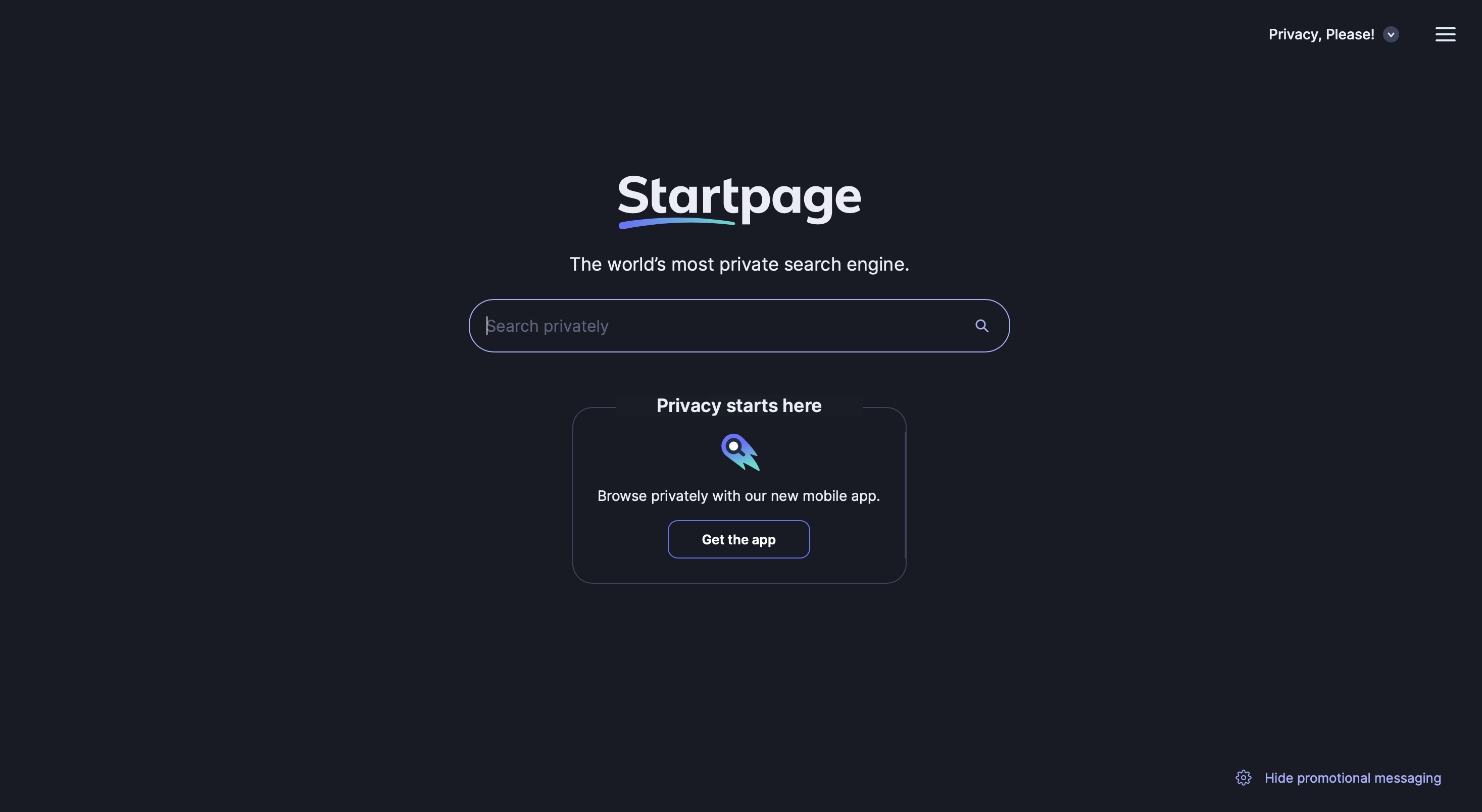
Startpage acts as a proxy, allowing users to access Google and Bing search results without giving away their personal data. It strips all identifying information from your query and then makes the query. Such a tactic makes it stand out from other private search engines with a balance between anonymity and search result accuracy.
Main features:
- Anonymous view feature - browse web pages from search results without leaving a trace.
- No personal data - all search data, IP address, and other details are stripped away from your search.
- Neutral results - no price trackers, retargeting ads, or any profiling that may affect results.
2. DuckDuckGo
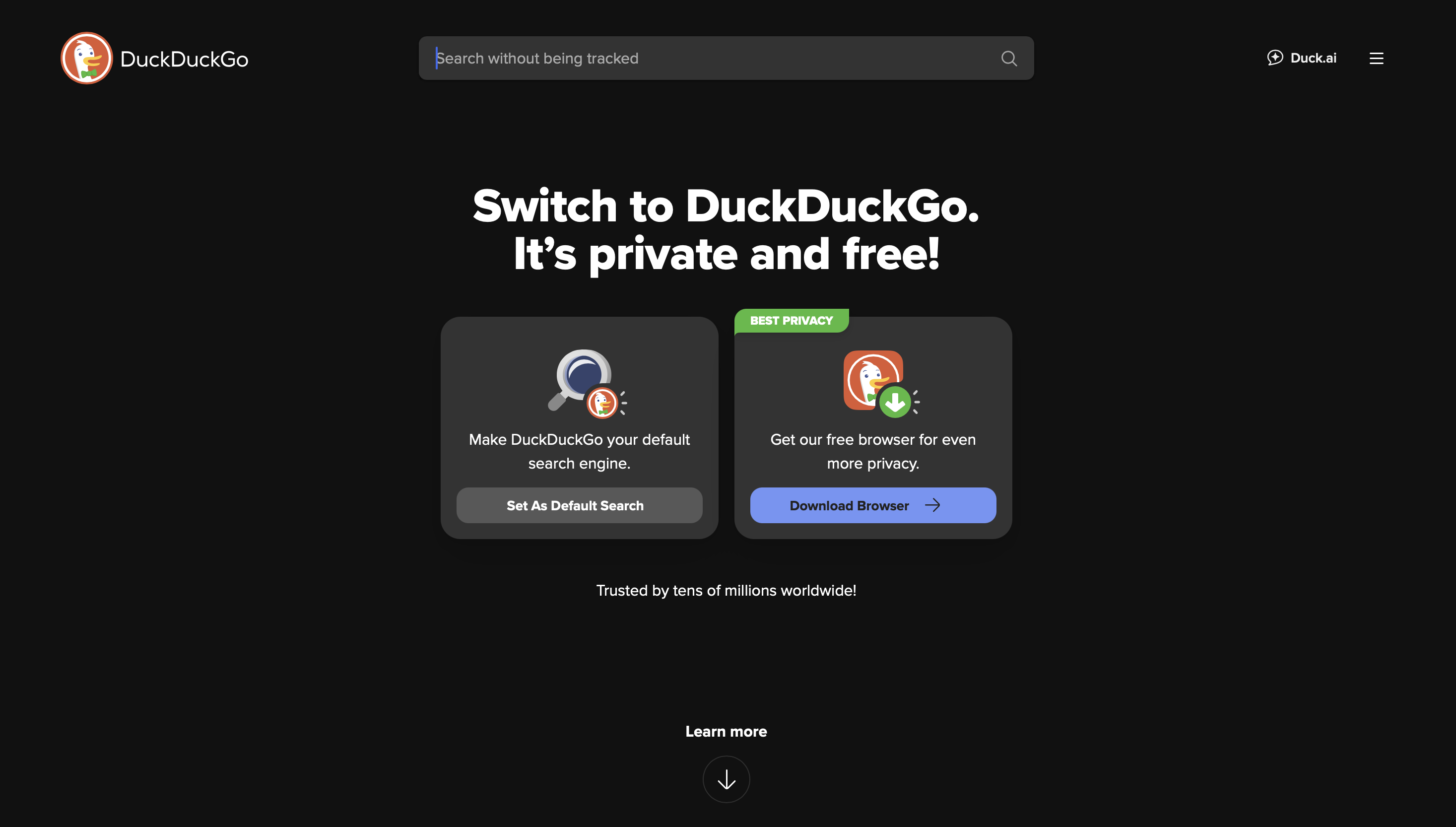
DuckDuckGo collects the bulk of its index from Bing and their own crawler with 400 partners. It's one of the most popular private search engines, never sharing your personal data and requiring an account. Recently, their team expanded on building a privacy-first ecosystem with email service, tracker blocking, and even Duck AI.
Main features:
- Privacy Ecosystem - web browser, tracker blocking, smart encryption, email protection, Duck AI, and other features.
- Instant Answers - uses hundreds of sources to give you an accurate answer right away.
- Unprofiled results - no search history or IP logging, served ads aren't targeted.
3. Brave Search
Unlike other private search engines that provide search results via proxy or rely on mixed indexes, Brave Search has its own independent crawlers. About 90% of their results come from their own index. If you have Brave's private browser, you can also enable the search feature that mixes search data from the Brave index and Google anonymously.
Main features:
- Independent index - Brave search doesn't use third-party indexes or act as a proxy unless you want it.
- Anonymous mixing - Brave browser fetches results from Google anonymously.
- AI summarizer - privately finds and shows AI answers without personal data collection.
4. Mojeek
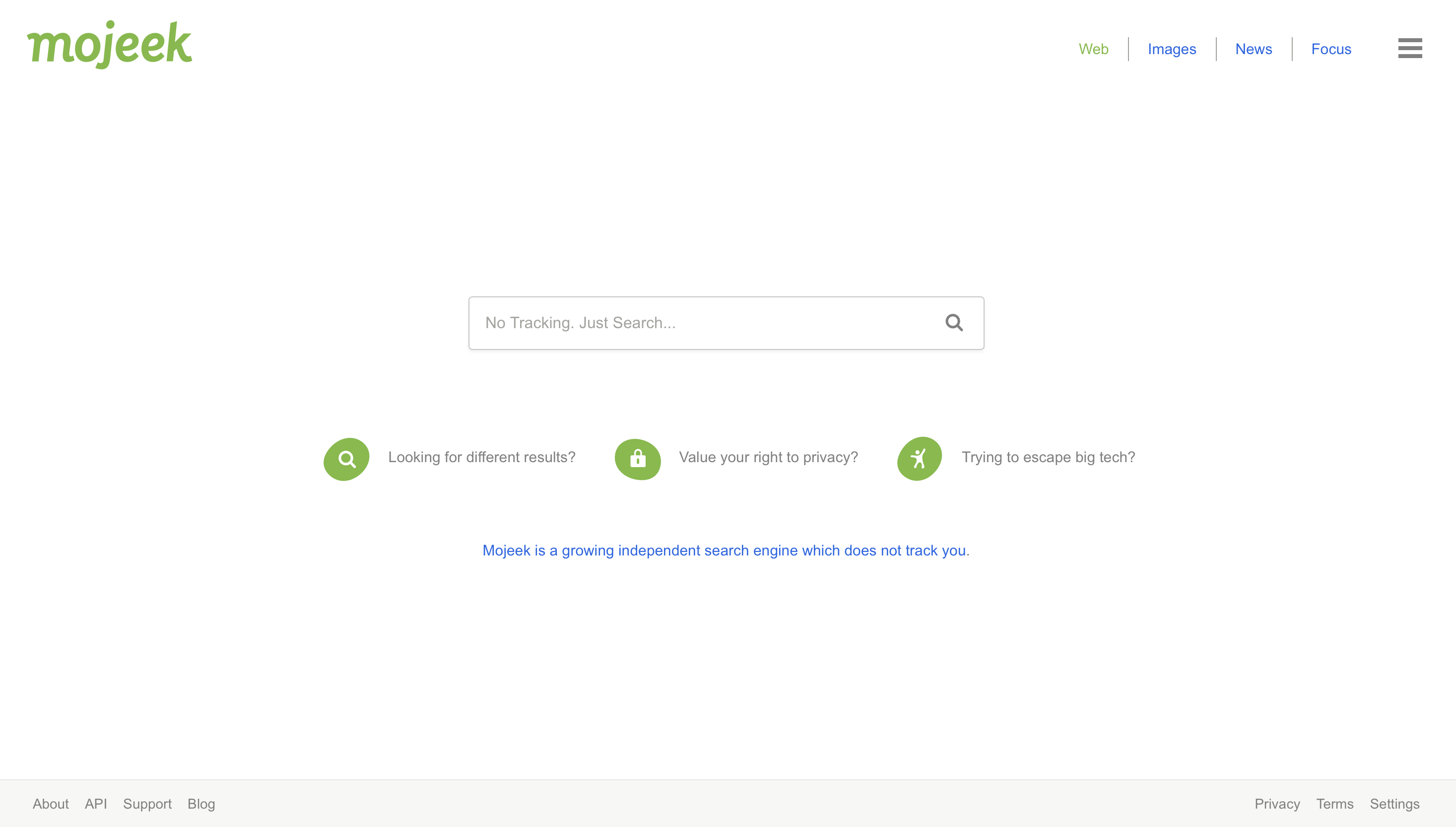
Mojeek is another alternative search engine that has its own index built from scratch. Unlike Brave, Moleek's search results strictly rely only on MojeekBot with no outside sources. This ensures Mojeek is truly independent and non-personalized, but the search results can be comparably lacking at times.
Main features:
- Strict no-tracking policy - it's the first search engine that does not track your search history at all.
- Independent index - 100% of search results come from Mojeek's own index.
- Mojeek Focus - users can create their own custom filters to specify which pages to use or exclude in their searches.
5. Qwant
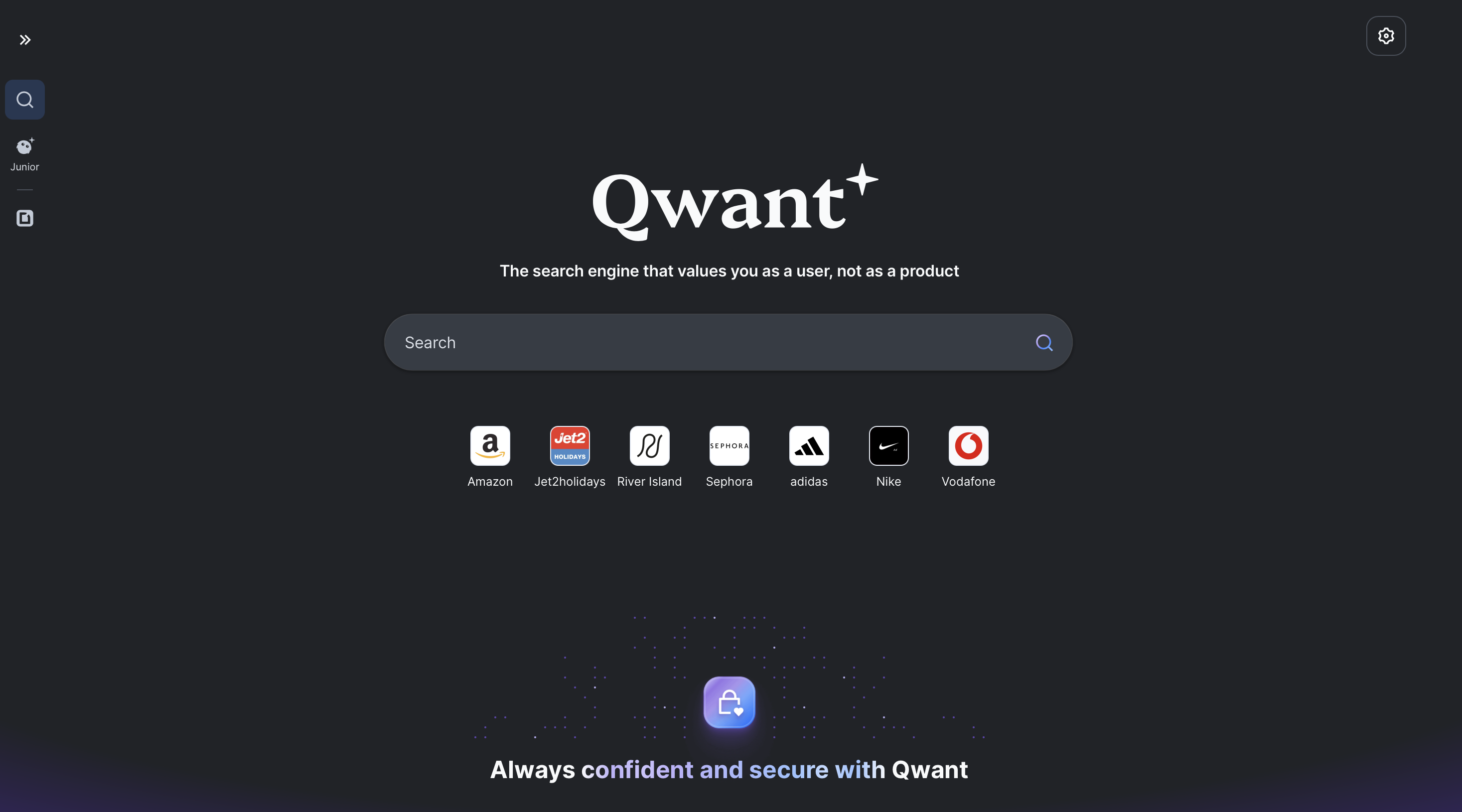
Qwant runs by a motto valuing you as a user, not as a product. Around 50% of their search results come from their own search index, and the remaining part, anonymously, from Bing. Qwant doesn't store any search history or personal data, with a lot of quickly growing new features, including a Browser extension, mobile app, and AI search.
Main features:
- GDPR compliance - as a European search engine, Qwant keeps up with the highest standards of user data safety.
- Anonymous search - does not log your search record or activity across the web in any way.
- Mobile app - Qwant search experience in a mobile-friendly browser interface based on Mozilla Firefox.
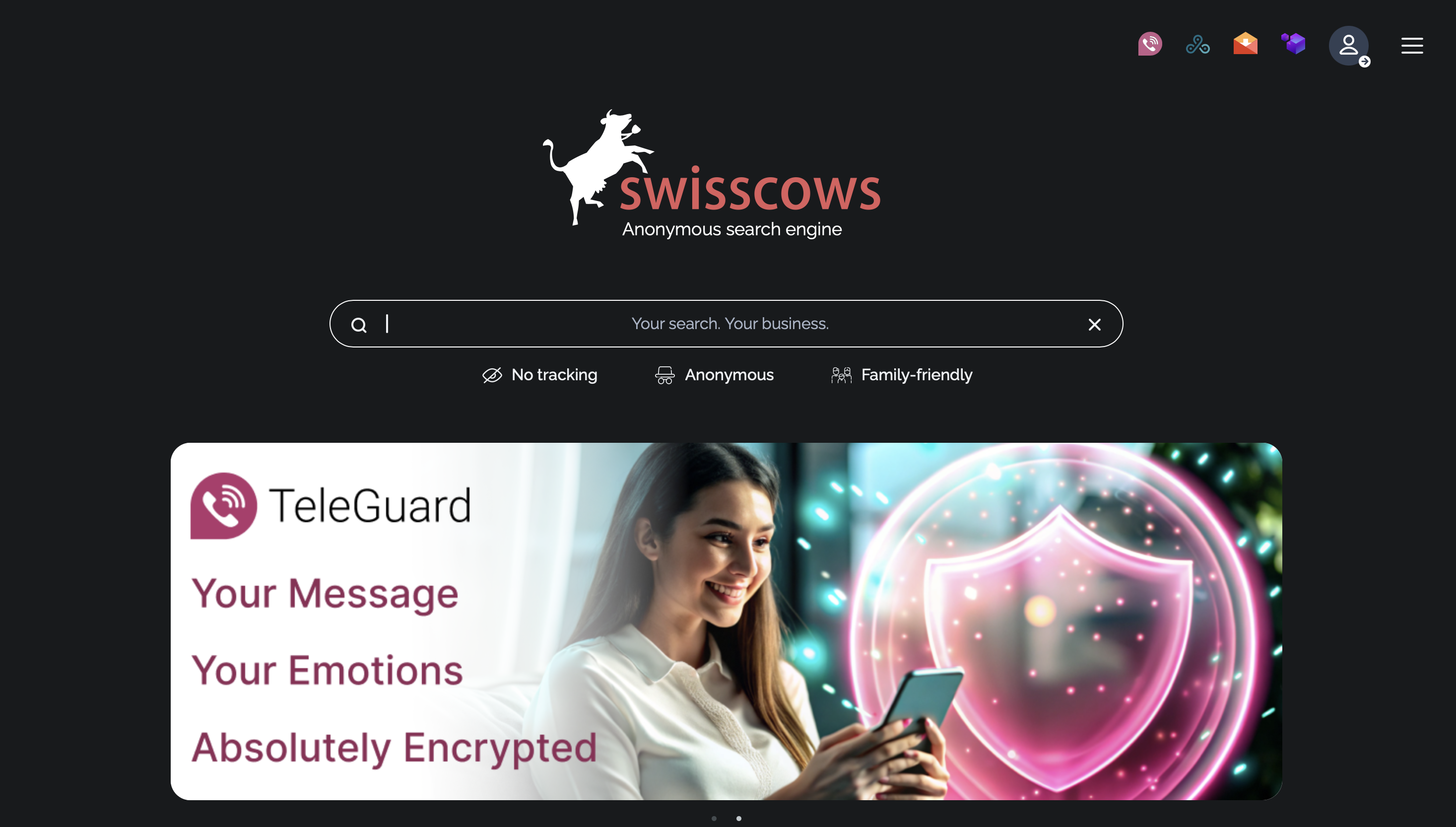
6. Swisscows
As the name might suggest, Swisscows is a search engine based in Switzerland, which has some of the strictest privacy laws. It's paid, but stores no user data and even goes a step further with its own physical servers. Swisscows has its search index for German queries and uses Bing for other languages.
Main features:
- Family-Friendly Filter - a very strict family filtering feature that cannot be turned off.
- Owns infrastructure - servers situated in a secure location in the Swiss Alps, outside privacy-intruding laws.
- Swisscows ecosystem - email, messenger, cloud storage, and other services under one hood.
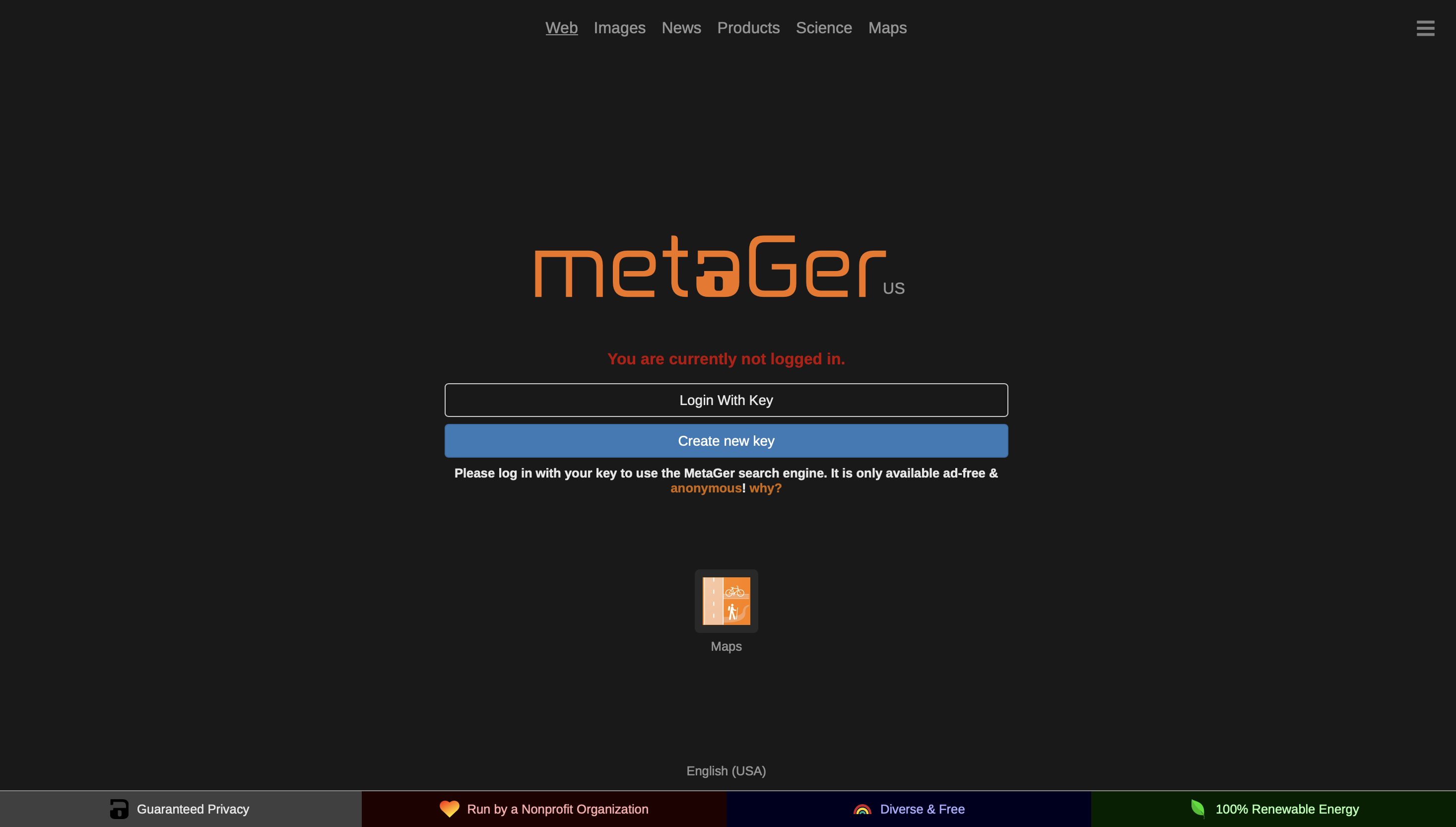
7. MetaGer
MetaGer is a metasearch engine that obtains search results through querying multiple underlying search engines without its own index. It aggregates and ranks the returned data for users while also running it through an anonymizing proxy. This search engine gives results without ads, but using it requires a subscription.
Main features:
- Open anonymously - every search result can be opened anonymously, so the destination only sees MetaGer's IP, not yours.
- Tor service - there's a Metger.onion mirror which is well maintained, fast, and with all the same functionalities.
- Open source and non-profit - MetaGer is run by a non-profit that provides all the source code to users.
8. SearX
Similar to MetaGer, SearX (now largely succeeded by SearXNG instances) is a metasearch engine that aggregates results from multiple sources without tracking users. Searx is open-source, meaning anyone can download the code and create their own instance. It stands out with many configurations for the search results aggregation.

Main features:
- IP stripping - the search engine uses Google, Bing, or other sources without telling them your IP address, routing the traffic through instance servers.
- Anonymous result proxy - special links can use proxies to access the webpages, not just results, through the SearXNG server.
- Open source - the code of the search engine can be inspected and used by anyone, giving you full control of the vast search aggregation targets.
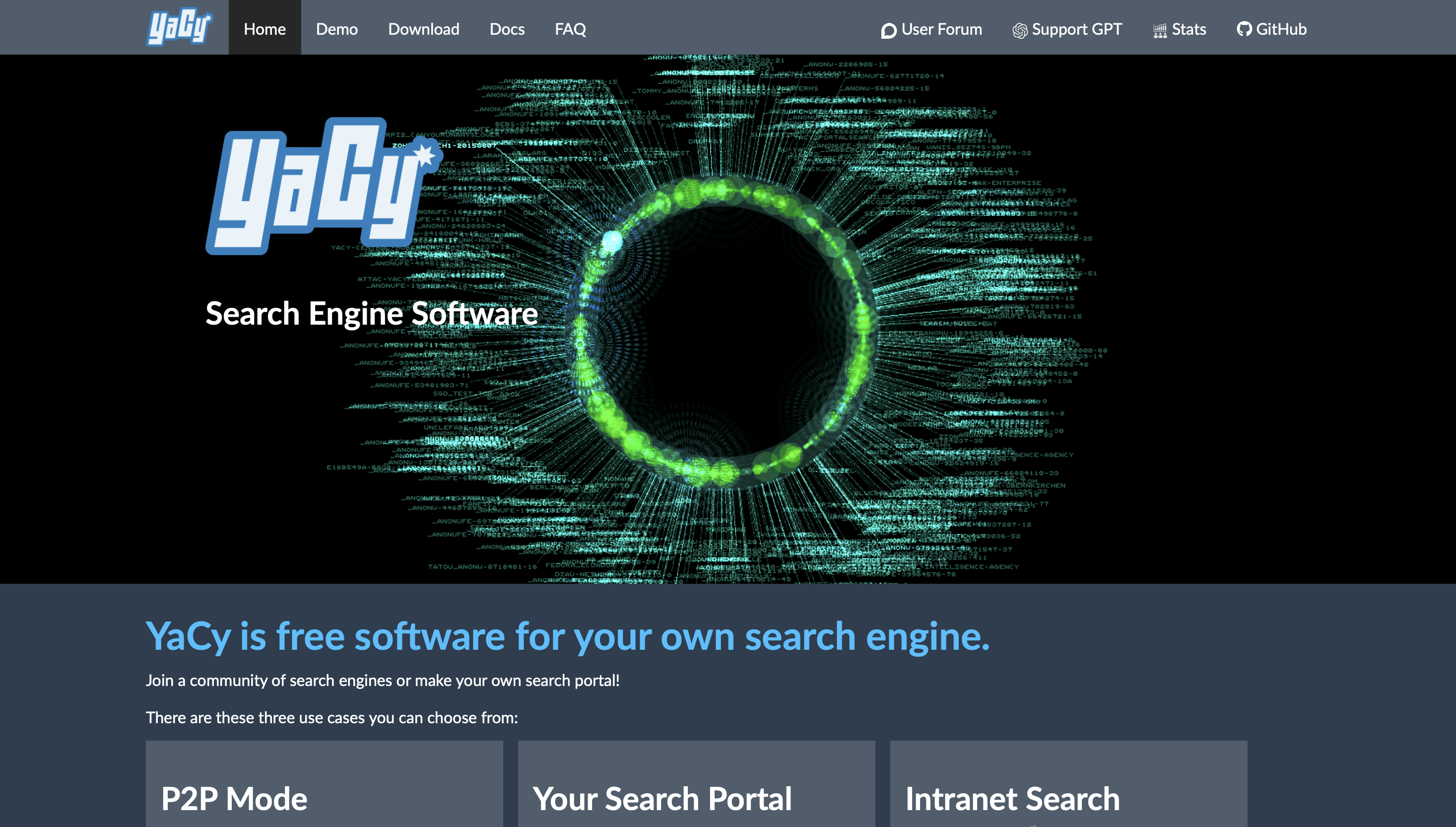
9. YaCy
YaCy is not exactly a private search engine, but a torrent-like search engine software that lets you create one on your own. It functions as a distributed peer-to-peer search platform without central servers. Each user's installation (peer) contributes equally to crawling, indexing, and searching. While advanced for user privacy, YaCy requires advanced technical knowledge.
Main features:
- Censorship-free - no central servers means no one can shut down or limit what you can search for using YaCy.
- Private customizations - indexing can be made locally, which gives you much flexibility in creating a truly private search engine.
- Tor integrations - YaCy can be set up to index .onion pages and the Freenet, expanding your search engine reach.
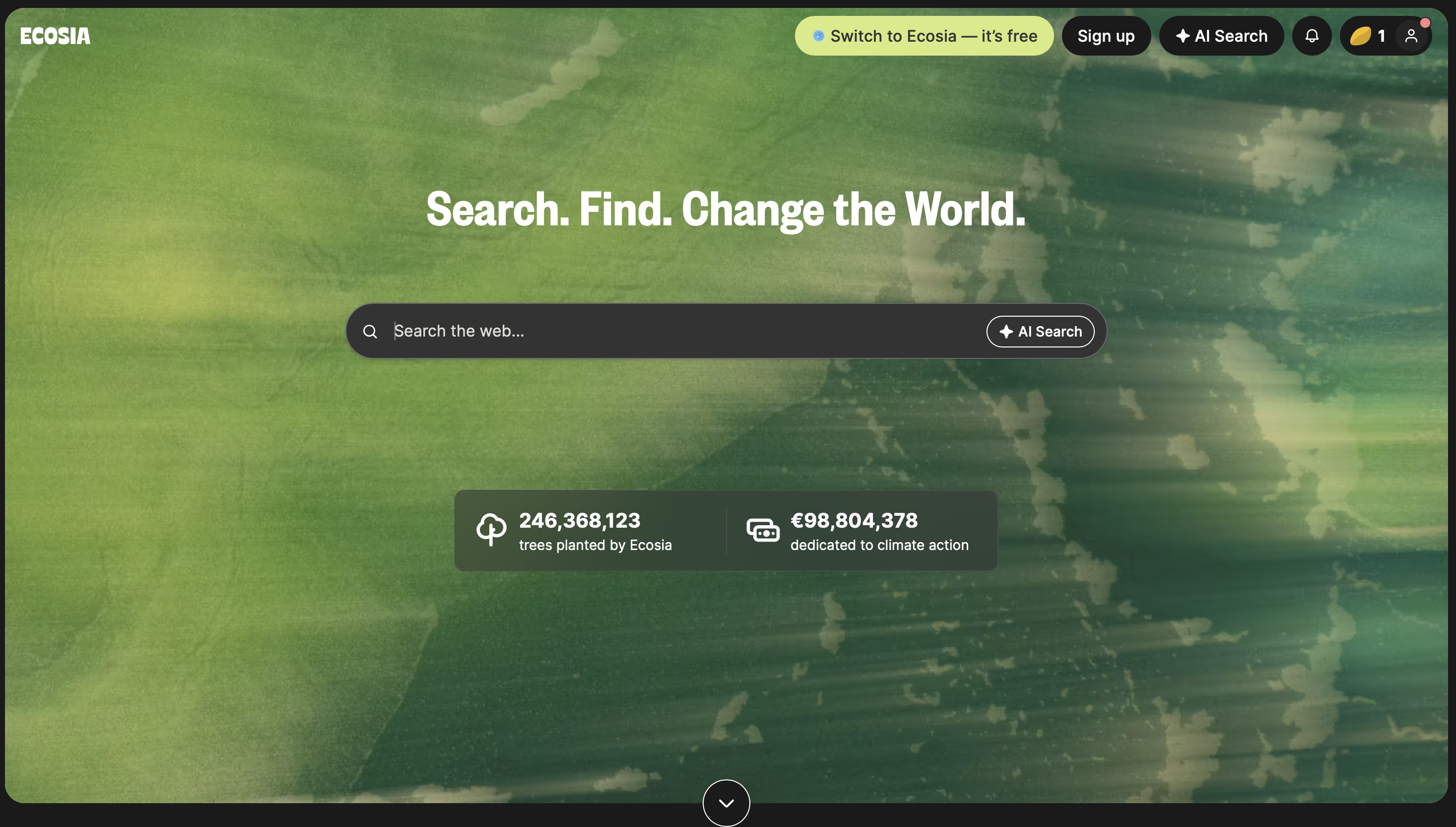
10. Ecosia
Environmental focus sets Ecosia apart from all other search engines. They use most of their ad revenue profits to fund global tree-planting and environmental projects. Ecosia is also privacy-friendly as it does not create user profiles from search history, anonymizes data, and avoids user targeting for advertisers.
Main features:
- Transparency - Ecosia publishes monthly financial reports showing exactly how much money they made and what environmental projects they funded.
- Green features - highlighting of eco-friendly organizations (green leaf icon) and showing a rating of the climate friendliness of major companies.
- Ecosia AI - provides AI answers based on OpenAI's models but optimized for sustainability and as little environmental impact as possible.
Privacy focus | Results accuracy | Ease of use | Jurisdiction | Tor integration | Is it paid? | |
|---|---|---|---|---|---|---|
| Startpage | Very High | Excellent | High | Netherlands | None | Free (Ad-supported) |
| DuckDuckGo | High | Good | High | USA | Yes | Free (Ad-supported) |
| Brave Search | Very High | Good | High | USA | Yes | Free (Ad-supported) or paid |
| Mojeek | High | Fair | Medium | UK | None | Free |
| Qwant | High | Good | High | France | None | Free (Ad-supported) |
| Swisscows | High | Good | High | Switzerland | None | Free (Ad-supported) |
| MetaGer | Very High | Excellent | Medium | Germany | Yes | Paid |
| SearXNG | Maximum | Excellent | Medium | Varies | Yes | Free (Open source) |
| YaCy | Maximum | Poor | Low | Decentralized | Yes | Free (Open source) |
| Ecosia | Moderate | Good | High | Germany | None | Free (Ad-supported) |
What to Look for in a Privacy-First Search Engine
It's a common misconception that using an incognito mode on a browser or logging off from your account will ensure privacy. Private search engines can do much more to ensure your data safety, but you must be intentional when looking for the relevant features.
- No logging or tracking. The best privacy search engines are straightforward and technical about how they use your IP, search history, profile information, or similar data points. While no search engine is completely without them, it's important to avoid marketing slogans only and look for real specifications and reviews.
- Encrypted search queries. As a minimum, all traffic should be shared over HTTPS to stop passive tracking or simple inspection methods from your Internet Service Provider (ISP). Some privacy-focused search engines also encrypt data on their servers to obscure records of your connection.
- No personalized ads. If a private search engine includes personalized ads, you can know it's not really private. Such targeted ads are not possible without cross-site identifiers or your profile behavior. It's a clear red flag that all the user privacy promotion is just a marketing gimmick.
- Transparent data policies. Confusing privacy policies often mean a site is hiding harmful practices with personally identifying information. A good data policy is transparent and easy to understand, explaining what information is collected and what its purpose is.
Using a VPN with Private Search Engine
No matter how good your private search engine is, there are still multiple weak points for your personal data. There are DNS leaks, browser fingerprints, and many other privacy threats, but the biggest of them is an exposed IP address.
This unique string of characters identifies every device online and can show websites your approximate location and ISP name. Even if you use a private search engine, every website you click on will be able to access identifying information from your IP to track you.
Using a quality VPN service is the most user-friendly way of changing your IP and ensuring you remain anonymous. With a couple of clicks, you can route your traffic through an encrypted VPN server using an IP address from almost anywhere in the world.
The best part is that VPNs aren't a niche product for privacy enthusiasts. With less than two dollars per month, you can use CometVPN and start protecting your privacy now.
Search Engines to Avoid for Privacy
Much like no unbiased news source is truly unbiased, no search engine is completely neutral and free of tracking. The best alternative search engines can achieve is to be transparent about their algorithms and business models. Traditional search engines, however, are known for aggressive data monetization tactics.
- Google's business model overwhelmingly relies on advertising, which isn't possible without the extensive user profiles they keep on everyone using their services. It's no secret that third-party advertisers are buying access to these profiles, and Google is making billions out of it.
- Bing is a less successful Google clone that relies on making revenue from targeted ads. If you're signed into a Microsoft account, search history syncs across devices and is stored long-term. Most of the data is likely for internal use, but the privacy policy reserves the right to share the data with third parties.
- Yahoo explicitly associates activity across devices and accounts under a single user ID. While it has changed owners multiple times, its business model has always stayed based on sharing your personal search data with advertising partners. Compared to Google and Microsoft, they get much less scrutiny for the accountability of their data policies.
Despite the differences in business models, privacy-focused search engines can still be risky for your privacy if you don't use them carefully. Avoid entering your identifying information, and critically evaluate all the links you press while using them.
Frequently Asked Questions
Which browser has the best private browsing?
The answer varies based on your personal needs and preferences. Browsers like Firefox (with privacy addons, such as uBlock Origin) and Brave are generally considered the most private while still convenient to use. Tor Browser is best for user privacy and anonymity, but it's slower and might not work on all websites.
What browser is 100% private?
Tor Browser is widely considered the most private, but no browser is 100% safe, as there are multiple factors at play. It's recommended to increase privacy with additional tools, like VPNs, custom DNS servers, and privacy-focused search engines. You also should conceal personal identifying information and avoid sites that aggressively collect user data.
What search engine can't be tracked?
No search engine is completely untraceable, as at least your IP address and browser fingerprint are exposed to websites you visit. Search engines like Startpage, DuckDuckGo, and Brave make efforts to minimize the privacy risks, but tools like VPNs and privacy browsers are still needed.
Is DuckDuckGo more private than Google?
Yes, DuckDuckGo is widely considered to be a more private search engine than Google. It doesn't track your searches, build a personal profile, or log your activity in other ways. Google collects user data to offer targeted ads for its real customers - businesses in need of online advertising.
Author
Guoda Šulcaitė
Growth Manager at CometVPN
Guoda is an all-round marketing professional with deep knowledge in the tech SaaS industry, particularly VPNs and proxies. She has worked on numerous projects and helped achieve impressive results through project management, content production, and SEO.
Related articles
4 min read
Ethernet vs Wi-Fi: Which One is Better?
Ethernet and Wi-Fi are the two main ways to connect your computer to the internet. While Wi-Fi has received significantly more attention in recent years, especially among consumers, due to its simplicity and flexibility, ethernet is still widely used in various other applications.
Even if Wi-Fi is significantly more popular, it isn’t strictly better. Both methods have their benefits and drawbacks. Wi-Fi’s popularity comes from its ease-of-use and flexibility, but an ethernet connection can be much more useful in certain scenarios.

Adomas Šulcas

5 min read
How to Change Chrome Proxy Settings: The Ultimate Guide
A proxy server is an easy alternative to a VPN that can perform most of the functions of the latter. It’s a server that stands between your device and the destination server, taking your connection requests and forwarding them in your name.
Destination servers in almost all cases see the proxy server as the originator of the request. As such, proxies are widely used in various, mostly business-related applications whenever privacy, security, location changing, and several other factors are at play.
Guoda Šulcaitė